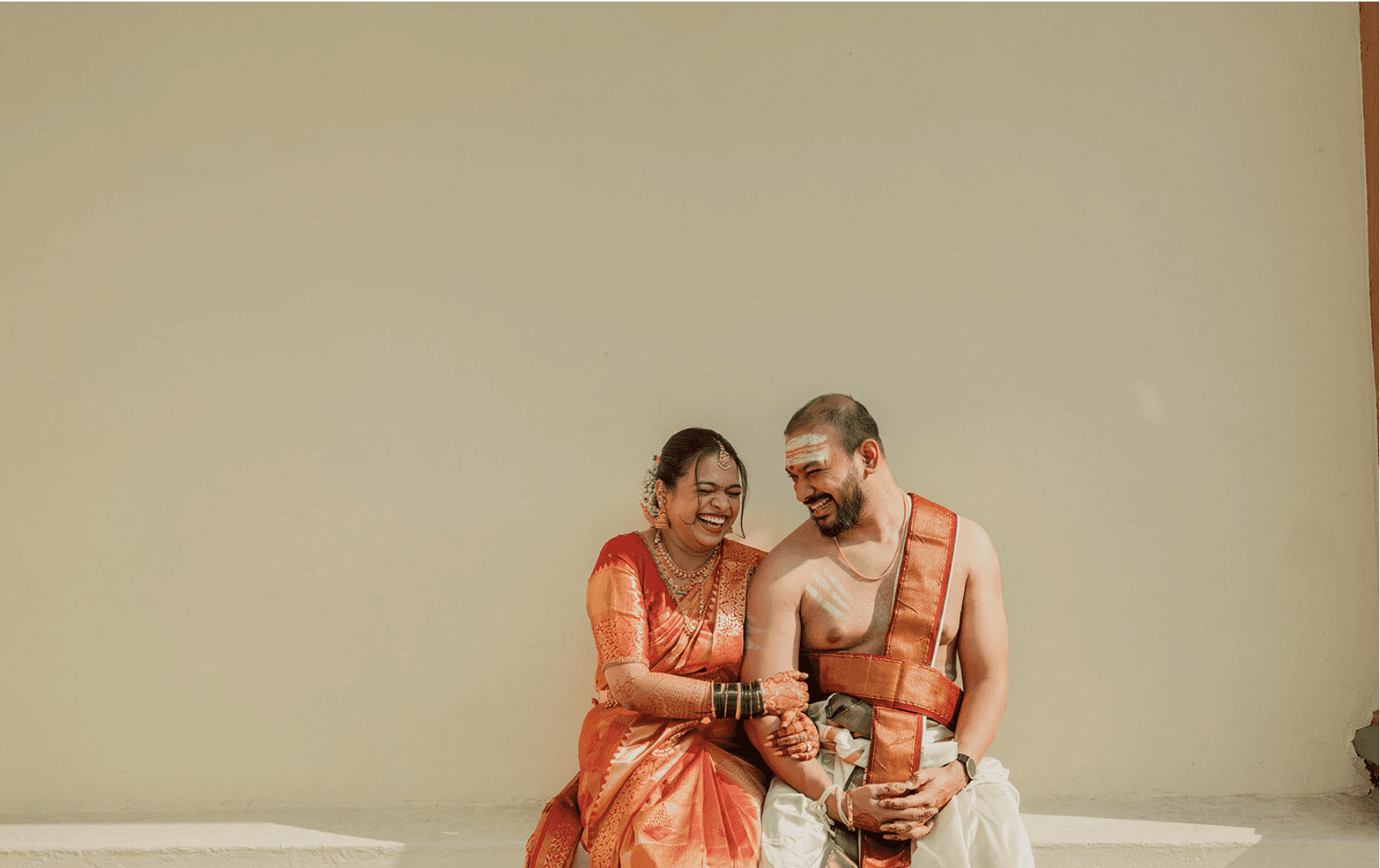
Maharashtrian weddings are quieter than many other Indian wedding traditions — and that quietness is exactly what makes them so rewarding to photograph.
There's less choreography, fewer performances built for an audience, and far more ritual carrying genuine emotional weight in real time. For a candid photographer, that's the difference between waiting for moments to be performed and watching them actually happen.
If you're a Maharashtrian couple planning your wedding, or simply researching what to expect from your ceremonies, this guide walks through the major rituals in order — Simantpoojan, Antarpat, Haldi, Mangalashtak, and Saptapadi — what each looks like, where the emotional peaks usually are, and what couples (and photographers) often miss.
Simantpoojan — The Welcome at the Mandap Gate
Simantpoojan is one of the first rituals of the wedding day, performed at the entrance of the mandap. The groom arrives, and the bride's father — sometimes joined by other elders — formally welcomes him, washing his feet and offering him a warm reception into the family.
Photographically, this ritual is about thresholds — quite literally. The groom standing at the entrance, the bride's father bent in welcome, the first formal acknowledgment between the two families as they're about to be joined. It's a small ritual in terms of duration, but it sets the tone for everything that follows.
What's often missed: the expressions on the groom's side of the family during this moment. Everyone is watching the bride's father, but the groom's parents — seeing their son being welcomed into a new family — often have some of the most quietly emotional reactions of the entire day. A good photographer positions a second shooter to catch this side of the frame.
Antarpat — The Curtain Between Them
The Antarpat is, in our experience, one of the most photographically interesting rituals in any Maharashtrian wedding — and one of the most overlooked by photographers who don't know to look for it.
A cloth curtain — the antarpat — is held up between the bride and groom just before the Mangalashtak begins, so they cannot see each other. As the auspicious mantras are chanted, the curtain is lowered, and the couple sees each other for the first time that day — often for the first time in days, depending on how the wedding week has gone.
The moment the curtain drops is, frame for frame, one of the most reliably emotional moments in the entire wedding. Tears, laughter, a sharp intake of breath — something happens on both faces in that half-second, and it happens only once. There is no retake.
What's often missed: couples (and sometimes photographers) treat this as a transitional moment rather than a key one — something to get through before the "real" ceremony starts. In reality, it's often the single most candid, unguarded expression either of them will have all day. We always position for this shot specifically, on both sides of the curtain, because it only happens once and it happens fast.
Haldi — More Than Just Turmeric
Maharashtrian haldi ceremonies — sometimes called the Mangal Snan — happen separately for the bride and groom, usually on the morning of the wedding or the day before. Family members apply a paste of turmeric, often mixed with milk or rose water, while folk songs are sung.
What makes Maharashtrian haldi visually distinct from other regional versions is its relative simplicity. There's often less elaborate decor and fewer theatrical elements — which means the focus stays entirely on the people. Grandmothers applying haldi with practised hands. Younger cousins getting overenthusiastic with the paste. The specific texture of turmeric catching morning light.
What's often missed: the haldi ceremony is frequently treated as a "getting ready" formality — something to get through before the real photography begins. But some of the most textured, warm, family-centric images of the entire wedding come from haldi, precisely because nobody is performing for the camera yet. Couples should make sure their photography coverage starts before the haldi, not after it.
Mangalashtak — Eight Verses, One Fire
The Mangalashtak is the heart of a Maharashtrian wedding ceremony — eight Sanskrit shlokas recited or sung as the couple takes their pheras (rounds) around the sacred fire. Each verse is a blessing, addressing different aspects of the marriage: health, prosperity, wisdom, and long life among them.
Visually and emotionally, this is where a Maharashtrian wedding builds to its peak. The priest's recitation, rice grains being showered by guests at specific intervals, the rhythm of the rounds around the fire — it has a built-in structure that, once a photographer understands it, becomes highly predictable in the best way. You know what's coming, which means you can be positioned for it.
The eighth and final shloka — and the moment immediately after it — tends to be where the most visible relief and joy appears on both families' faces. The formal part of the ceremony is, in a sense, complete.
What's often missed: the rice shower moments. Guests throwing akshata (rice mixed with turmeric) at specific points during the Mangalashtak create some of the most dynamic, motion-filled frames of the day — but they happen fast, repeatedly, and from multiple directions. A second shooter positioned among the guests, rather than only at the mandap, captures an entirely different (and often more energetic) version of the same ritual.
Saptapadi — The Seven Steps
The Saptapadi follows the Mangalashtak and is, in many ways, its emotional resolution. The couple takes seven steps together around the fire, each step representing a specific vow — for nourishment, strength, prosperity, happiness, progeny, longevity, and friendship.
Unlike the Mangalashtak, which has a slightly more formal, observed quality, the Saptapadi often feels more intimate — the couple is now moving together, in sync, often holding hands or with the bride's saree tied to the groom's garment (the gathbandhan). It's physical in a way the earlier rituals aren't, and that physicality translates directly into the photographs.
What's often missed: the in-between steps, not just the start and end of the Saptapadi. Couples and photographers alike sometimes treat this as "seven steps, get the wide shot, done" — but the small moments between steps, a shared glance, a whispered word, a stumble and recovery, are often where the real emotion lives. Slowing down here, rather than rushing to the next ritual, makes a meaningful difference to the final gallery.
A Real Example — Sharwari & Dhruva at Sula Vineyards
We recently photographed exactly this sequence at Sharwari & Dhruva's wedding at Sula Vineyards in Nashik — a destination wedding that still centred around traditional Maharashtrian rituals, including the Mangalashtak, performed against the backdrop of the vineyards at golden hour.
What stayed with us from that wedding wasn't the location, beautiful as it was — it was watching two families who knew these rituals by heart move through them with complete ease, while the setting around them was entirely new. The rituals carried their own weight regardless of where they happened. If you'd like to see how Maharashtrian traditions translate to a destination setting, their full story is on our blog.
Planning Your Maharashtrian Wedding Photography
If there's one thing to take away from this guide, it's that Maharashtrian weddings reward photographers who know the sequence in advance. Because so much of the ritual flow is precise — the antarpat drop, the akshata showers, the seven steps — a photographer who has to ask "what happens next?" during the ceremony will always be a half-second behind the moment.
We've photographed Maharashtrian weddings across Mumbai, Pune, Nashik, and as destination celebrations further afield — and we'd be glad to walk you through exactly how we approach each ritual for your specific wedding.