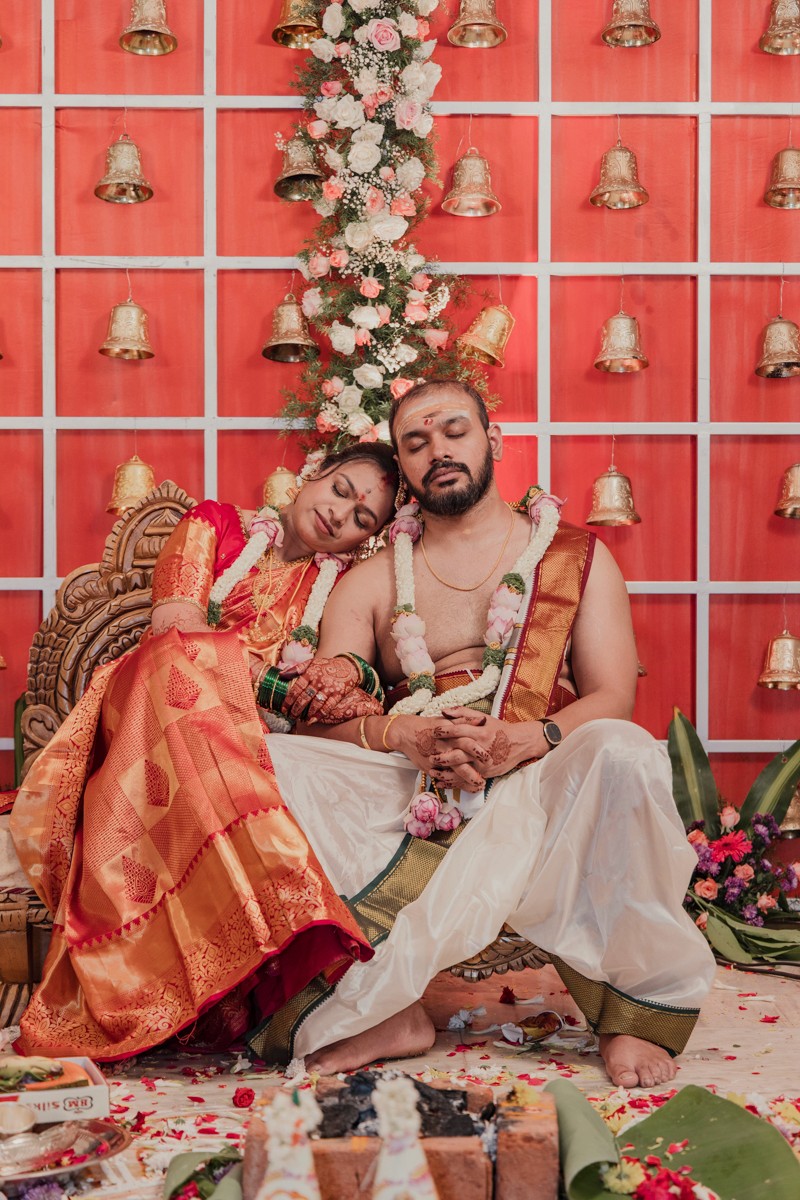
Naandi · Vratham · Muhurtham · Nalangu | Tamil Iyer Wedding Photographer | Mumbai
Tamil Iyer weddings are among the most ritually precise celebrations in the Indian wedding calendar. Every ceremony has a defined sequence, a defined meaning, and a defined role for every family member involved. Nothing is vague. Nothing is approximate. And if you are a photographer who doesn't know what is coming next, you will miss it.
This is a guide for couples planning a Tamil Iyer wedding — and for anyone trying to understand what these ceremonies actually look like through a camera. We cover the Naandi, the Vratham, the Muhurtham, and the Nalangu — what each is, where the emotional peaks are, and what photographers consistently miss when they haven't shot an Iyer wedding before.
Naandi — The Ancestral Blessing
The Naandi is the formal opening of the entire wedding — a puja performed to invoke the blessings of the couple's ancestors before any of the wedding rituals begin. It is quiet, specific, and deeply intentional. Priests recite specific gotras and lineages, anchoring the ceremony in the long family history that precedes this moment.
Photographically, the Naandi rewards close attention to the faces of elders in the room. This is a ritual that carries visible weight for grandparents and older family members — the acknowledgment of ancestry in a formal setting often produces emotional expressions that no other part of the wedding replicates.
What's often missed: the moment the Naandi concludes and the main wedding sequence begins. There's a visible shift in the room — a collective inhale, a change in posture, a family moving from preparation into ceremony. That transition is worth capturing and rarely is.
Vratham — The Bride and Groom's Separate Ceremonies
The Vratham ceremonies — one for the bride, one for the groom — take place separately and mark the formal beginning of each person's transformation into a married individual. Both involve specific rituals of purification and vow-taking, conducted with family present, before the couple is brought together for the main ceremony.
The groom's Vratham includes the Kasi Yatra — a beautifully theatrical moment in which the groom announces his intention to renounce the world and travel to Kashi to pursue a life of asceticism. The bride's father intercepts him, argues the merits of the householder's life, and offers his daughter's hand instead. The groom — inevitably — agrees to stay.
It is one of the most openly playful rituals in any Indian wedding tradition, and one of the most reliably joyful to photograph. The groom walking away with an umbrella and a fan, the family surrounding him, the bride's father making his case — guests who haven't seen it before are visibly delighted.
What's often missed: the bride's Vratham, which happens simultaneously or just before. It is quieter and more inward-facing than the Kasi Yatra, and because it competes photographically with the more theatrical groom's ceremony, it is frequently under-covered. A second shooter positioned with the bride during her Vratham makes a significant difference to how complete the final gallery feels.
Muhurtam - The Main Ceremony
The Muhurtham is the heart of the Tamil Iyer wedding — the main ceremony in which the couple is formally united. It begins with the Kanyadanam, the formal giving of the bride by her father, a moment of genuine emotional weight that is one of the most important photographs of the entire wedding.
It is followed by the Maalai Maatral — the exchange of garlands between the bride and groom. Unlike the North Indian Jaimala, the Iyer Maalai Maatral is typically less boisterous and more emotionally contained — though the groom's side will often try to lift him to prevent the bride from garlanding him first, and the resulting chaos has its own joy. The sequence happens fast. A photographer who isn't already positioned will miss it.
Then the Muhurtham reaches its most significant moment: the tying of the Thali. The Thali — a sacred gold pendant on a turmeric-dyed thread — is tied around the bride's neck by the groom at the auspicious Muhurtham time. The priest counts down, the room goes still, and the groom leans forward while family members shower the couple with akshata from all directions.
What's often missed: the bride's face during the Thali tying. Every camera points at the groom's hands and the Thali. The bride's expression in this exact moment — the held breath, the stillness, the specific quality of her eyes — is often not captured because nobody positioned a camera on her side. It is one of the most significant misses in Tamil wedding photography.
Following the Thali, the couple takes their Saptapadi — seven sacred steps around the fire, each a vow. In the Iyer tradition the bride's saree pallu is tied to the groom's shawl — the Kannikadanam. The visual of this physical joining — two people bound together, moving in the same direction — photographs with a quiet power that the larger moments earlier in the day don't always replicate.
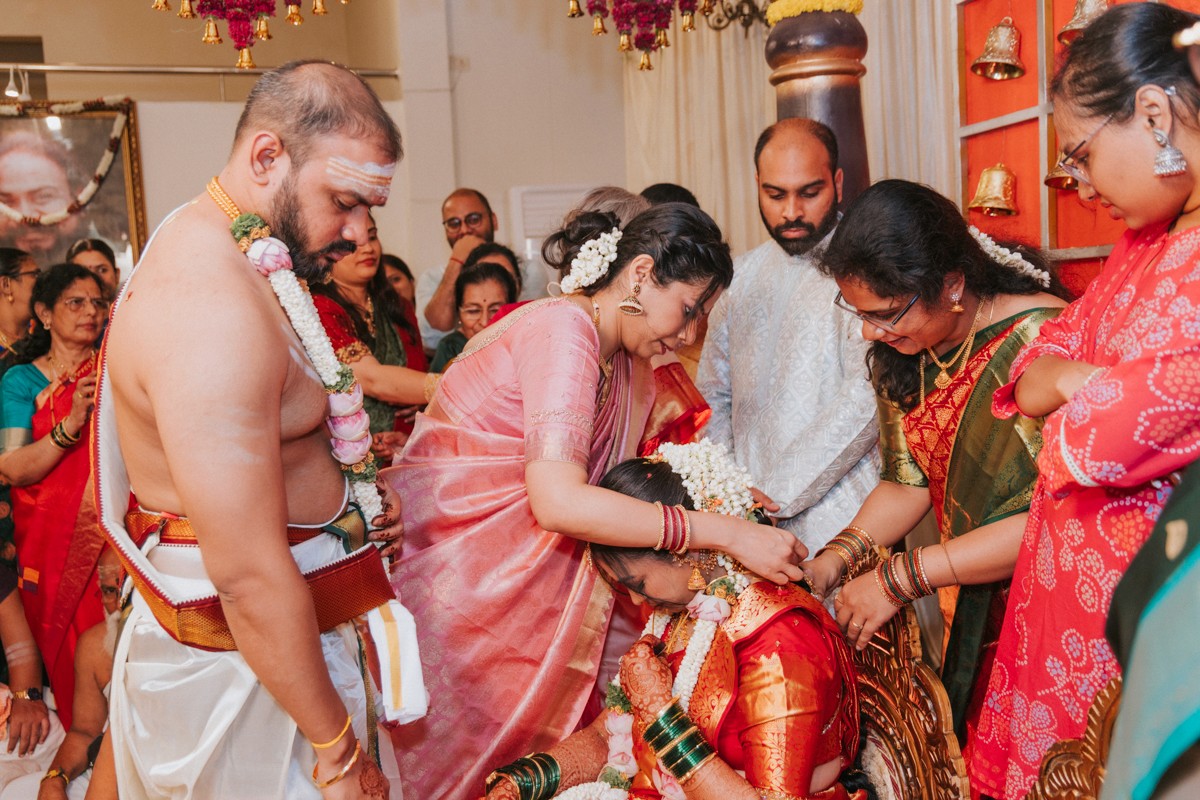
What's often missed: the Aashirvadham — the formal blessing by elders after the ceremony concludes. Family members come forward one by one, and the cumulative emotional weight — especially when elderly grandparents are among those blessing them — is significant and frequently under-photographed.
Nalangu — Where the Day Changes Tone
The Nalangu is the post-wedding celebration — playful games performed by the couple, surrounded by family, designed to help the newlyweds begin to know each other in a more relaxed setting. Turmeric paste, rose water, and competitions involving milk, rings, and flower petals are all typical elements.
The energy of the Nalangu is completely different from everything that precedes it. The ceremony is over. The formality lifts. And the couple, who have been serious and composed through hours of precise ritual, are suddenly laughing and teasing each other in front of their entire family.
For candid photography, the Nalangu is one of the most productive parts of a Tamil Iyer wedding — because for the first time all day, both the bride and groom are simply being themselves. Unguarded, present, enjoying the moment rather than moving through it.
What's often missed: the bride's female relatives surrounding her during the Nalangu — aunts, cousins, sisters — the specific dynamic of the women in the room, their laughter and involvement, is often lost when a photographer focuses entirely on the couple at the centre.
Real Tamil Iyer Weddings We've Photographed
We've had the privilege of photographing Tamil Iyer traditions across two weddings — each with its own character, but both holding the full weight of this tradition.
Spoorty & Vivek's wedding in Karnataka was a Kannada-Tamil Iyer celebration that held both traditions with care — the full sequence from Naandi through Nalangu, every ritual in its correct order, a family that knew exactly what each moment meant and moved through it accordingly. Read their full story here
Nikita & Sayi's wedding in Andhra Pradesh brought the Tamil tradition into a Telugu-Tamil celebration — two complete ritual traditions held with equal seriousness across the same wedding. If you're planning an intercommunity South Indian wedding, their story shows what that balance looks like in practice.Read their full story here
Planning Your Tamil Iyer Wedding Photography
Tamil Iyer weddings demand a specific kind of preparation from a photographer. The rituals follow a sequence that cannot be interrupted, cannot be repeated, and — in several key moments — happens faster than most people outside the tradition expect. The Thali tying is over in seconds. The Kasi Yatra builds and resolves in minutes. The Maalai Maatral has no slow-motion replay.
A photographer who is learning the sequence as it unfolds will always be half a beat behind. A photographer who has done this before — who knows the Kasi Yatra is coming, who knows to position on the bride's side before the Thali is tied, who knows the Nalangu will be the most unguarded photographs of the day — will be ready.
We've photographed Tamil Iyer and Tamil-Telugu weddings across Karnataka and Andhra Pradesh, and we'd be glad to talk through your specific ceremony and how we'd approach it.
Want to see more South Indian Weddings. Browse more South Indian wedding stories
Frequently Asked Questions
What is the Kashi Yatra in a Tamil Iyer wedding?
The Kashi Yatra is a playful ritual in which the groom pretends to renounce worldly life and set off for Kashi. The bride's father stops him and offers his daughter's hand — one of the most joyful moments of the wedding.
What is the Muhurtham?
The Muhurtham is the main ceremony where the couple is formally united. It includes the Kanyadanam, the Maalai Maatral (exchange of garlands) and the tying of the Thali.
What is the Thali?
The Thali is a sacred gold pendant on a turmeric-dyed thread that the groom ties around the bride's neck. This moment is the heart of the marriage.
What is the Nalangu?
The Nalangu is the post-wedding celebration of playful games between the couple and family. With the formality over, it is the most relaxed and candid part of the day.




FAQ
The bride's face during Thali tying, the bride's Vratham ceremony, and the elders' Aashirvadham blessings are frequently under-photographed since attention tends to focus elsewhere.